
Semiconductor fab · Tube flushing · 3 chillers
Condenser approach temperature restored on LT and MT chillers
3.6 → 0.5 °CAverage condenser approach, before → after
85.6%Average improvement across 3 chillers

Semiconductor fabs
Process cooling water, chiller and cooling tower programmes for semiconductor fabs and assembly and test plants, where tight temperature tolerance leaves no room for unplanned downtime.
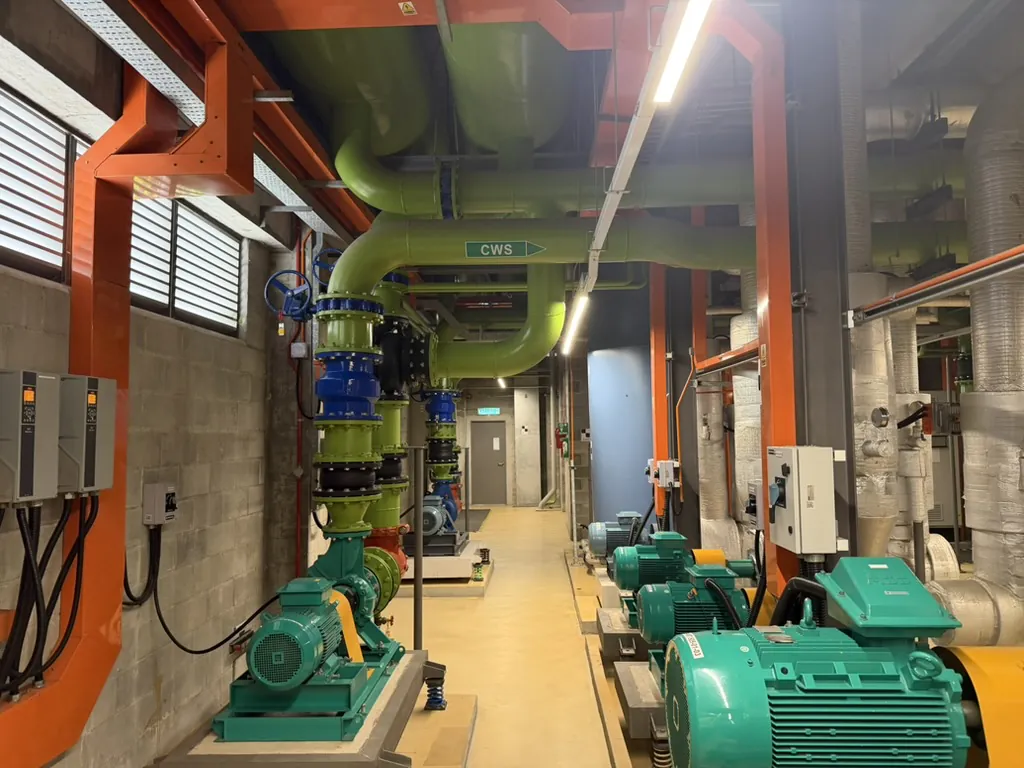
In a fab, process cooling water (PCW) removes heat from process tools and equipment through a closed loop held at a tight temperature and pressure. That heat goes to the chillers and on to the cooling towers. A problem anywhere in that chain shows up at the tool.
PCW loops are typically built from mild steel pipework with copper in the tool heat exchangers, many of which have small passages. Mild steel corrodes to iron oxide sludge and copper corrosion releases copper into the loop. Those corrosion products, together with biofilm and particulates, foul the small passages and change flow to the tool. On the condenser side, fouled tubes push up approach temperature and energy use in a plant that runs around the clock.
From the PCW loop to the cooling tower, with one team and one set of records.
| Systems | PCW, process chilled water, condenser loops, cooling towers |
|---|---|
| Work | Online; shutdown tasks planned with facilities |
| Integration | BMS-ready signals |
| Region | Penang, Kulim and nationwide |
You run a fab or assembly and test plant and need stable loops, documented control and planned rather than emergency maintenance.
Two low-temperature and one medium-temperature chiller were cleaned and put on a treatment programme.
Semiconductor fab · Tube flushing · 3 chillers
Closed loop corrosion and microbial control with Kurita Cetamine® programmes.
Learn more →02Industrial cooling towers and process chilled water loops under variable load.
Learn more →03Xylem VAF™ self-cleaning screen filters, sized and installed by Oasis.
Learn more →04Our HQ team covers Penang island, Seberang Perai and Kulim.
Learn more →Process cooling water is a closed loop that removes heat from process tools and equipment at a tightly controlled temperature and pressure. The heat is rejected through heat exchangers to the chiller and cooling tower system. Because tools depend on it, PCW quality and stability directly affect yield and uptime.
PCW loops are typically built from mild steel pipework with copper in the tool heat exchangers, many of which have small passages. Mild steel corrodes to iron oxide that settles as sludge in low-flow sections, while copper corrosion releases copper into the loop. Both foul those small passages and change flow to the tools. An inhibitor programme that protects mild steel and copper together, with regular monitoring of iron and copper levels, keeps the loop stable.
Routine treatment, dosing adjustments and testing are all done online while the plant runs. Work that needs a system out of service, such as condenser tube flushing, is planned with your facilities team for a scheduled window.
Approach temperature is the difference between the refrigerant condensing temperature and the condenser water leaving temperature. A clean condenser has a low approach. Scale, sludge and biofilm in the tubes push it up, so the compressor works harder. Each 1 °C rise in condensing temperature adds roughly 2–3% to compressor energy.
We sample your make-up and recirculating water, inspect the tower and condenser and return a written treatment proposal.